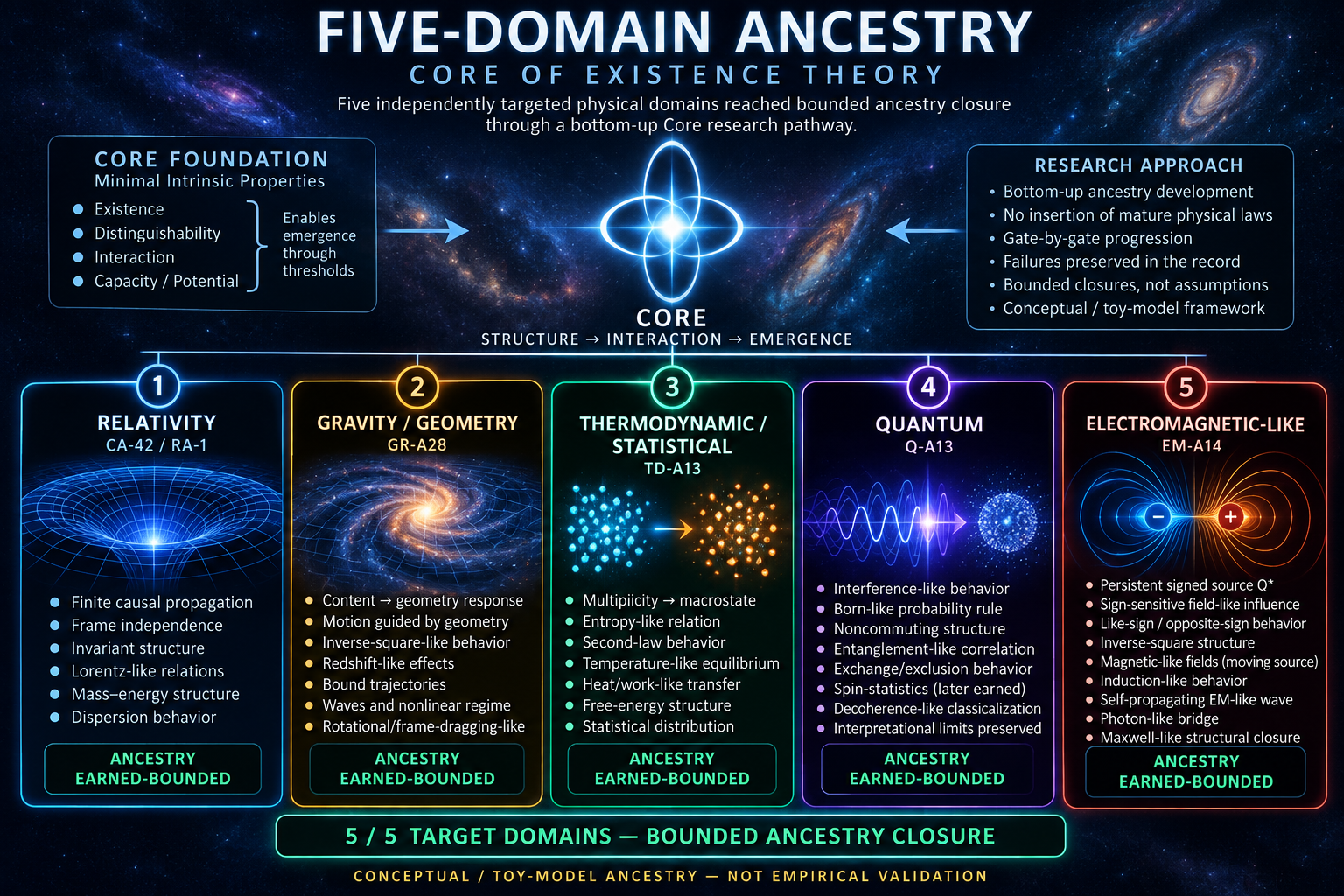
Five target physical domains reached bounded ancestry closure within the Core1 conceptual and toy-model research program. The diagram summarizes the ancestry record; it does not represent empirical validation of the corresponding established physical theories.
What Was Tested?
The objective was not to assume relativity, gravity, thermodynamics, quantum mechanics or electromagnetism and then reproduce them. The test was whether earlier Core ancestry could be extended, gate by gate, until structures resembling important features of those domains became available.
1. Relativity Ancestry
The relativity branch tested whether finite causal propagation, frame independence and invariant structure could develop into a relativistic-like kinematic and energy-momentum architecture.
Selected ancestry sequence
| Gate | Development | Status |
|---|---|---|
| CA-30 | Frame-independence structure | PASS-BOUNDED |
| CA-31 | Finite signal propagation | PASS |
| CA-32 | Invariant causal-speed candidate c* | SUPPORTED |
| CA-33 | Lorentz-like transformation structure | PASS |
| CA-34 | Relativistic conservation compatibility | PASS |
| CA-35–36 | Rest-state invariant and inertia/rest consistency | PASS |
| CA-38 | Structural mass-energy relation | PASS-BOUNDED |
| CA-40–41 | Zero-rest branch and limiting-speed behavior | PASS-BOUNDED |
| CA-42 | Relativistic-like dispersion structure | PASS-STRONG-BOUNDED |
| RA-1 | Relativity closure audit | ANCESTRY EARNED-BOUNDED |
E₀* ∝ m*(c*)²
(E*)² ~ (p*c*)² + (m*)²(c*)⁴
For the zero-rest branch, the candidate relation reduces structurally to:
Structural closure inside the Core model; not a measured derivation of physical special relativity.
2. Gravity / Geometry Ancestry
The gravity branch tested whether localized content could systematically alter relational geometry and whether that altered geometry could then guide motion and signal propagation.
GR-A1 → GR-A28
The sequence began with the weakest required bridge: content/concentration producing a systematic geometry response. It then tested whether geometry could influence free motion before progressing toward increasingly mature gravitational behavior.
| Range | Major development |
|---|---|
| GR-A1–A3 | Content → geometry response → motion → backreaction |
| GR-A4–A6 | Weak-field falloff, inverse-square-like scaling and universality |
| GR-A7–A9 | Clock-rate shift, redshift-like transfer and massless-signal deflection |
| GR-A10–A12 | Trapping/horizon-like behavior, reversible escape and bound trajectories |
| GR-A13–A15 | Kepler-like scaling, periapsis-precession-like behavior and delay |
| GR-A16–A20 | Geometry waves, energy transport, transverse structure, quadrupole-like radiation and reaction |
| GR-A21–A24 | Nonlinear geometry, strong-field consistency and compression/trapping separation |
| GR-A25–A27 | Moving-source geometry and rotational/frame-dragging-like behavior |
| GR-A28 | GRAVITY ANCESTRY EARNED-BOUNDED |
Compression-related observations encountered during this branch were kept separate from the Wave Rider program unless and until a dedicated cross-project compatibility test is performed.
A bounded structural ancestry result, not an empirical replacement for general relativity.
3. Thermodynamic / Statistical Ancestry
This branch tested whether statistical behavior could emerge from multiplicity, accessible configurations and exchange rather than assuming macroscopic thermodynamic laws at the beginning.
| Gate | Development |
|---|---|
| TD-A1 | Multiplicity → macrostate |
| TD-A2 | Entropy-like counting relation |
| TD-A3 | Statistical second-law behavior |
| TD-A4–A5 | Temperature-like equilibrium and zeroth-law-like transitivity |
| TD-A6–A7 | Heat-like/work-like transfer and Clausius-like relation |
| TD-A8 | Free-energy-like structure |
| TD-A9 | Canonical-like statistical distribution |
| TD-A10–A11 | Fluctuation-response and coarse-grained irreversibility |
| TD-A12 | Thermalization bounded by accessible sectors |
| TD-A13 | THERMODYNAMIC / STATISTICAL ANCESTRY EARNED-BOUNDED |
An important qualification survived the closure: the accessible state space matters. The appropriate counting relation therefore becomes, where required:
4. Quantum Ancestry
The quantum branch is especially important methodologically because the path was not a clean sequence of successes. Failed gates were preserved rather than retrofitted away.
| Gate | Development | Status |
|---|---|---|
| Q-A1 | Interference-like probability structure | PASS-BOUNDED |
| Q-A2 | Born-like quadratic probability rule | PASS-BOUNDED |
| Q-A3 | Noncommuting-observable-like structure | PASS-BOUNDED |
| Q-A4 | Bell-type nonclassical correlation / entanglement-like behavior | PASS-BOUNDED |
| Q-A5 | Indistinguishability, exchange and exclusion-like structure | PASS-BOUNDED |
| Q-A6 | Full spin-statistics connection | FAIL |
| Q-A7 | Richer 2π / 4π rotational topology; spin-like structure | PASS-BOUNDED |
| Q-A8 | Spin-statistics reattack | FAIL — FULL CONNECTION |
| Q-A9 | Local field-like excitation | PASS-BOUNDED |
| Q-A10 | Spin-statistics connection in bounded local relativistic field-like regime | PASS-BOUNDED |
| Q-A11 | Measurement classicalization / decoherence-like behavior | PASS-BOUNDED |
| Q-A11 | Fundamental single-outcome selection | FAIL / NOT EARNED |
| Q-A12 | Interpretation underdetermination retained | OPEN / BOUNDED |
| Q-A13 | Quantum closure audit | ANCESTRY EARNED-BOUNDED |
With explicit failures and interpretational limits preserved.
5. Electromagnetic-Like Ancestry
This branch provides another useful example of why failed gates matter. An earlier direct attempt to obtain charge-like attraction and repulsion failed. The later electromagnetic-like route required additional ancestry before sign-sensitive interaction could be earned.
| Gate | Development |
|---|---|
| EM-A1 | Persistent, signed, locally conserved source-like property Q* |
| EM-A2 | Source → sign-sensitive field-like influence |
| EM-A3 | Source/probe sign-product response; like-sign and opposite-sign behavior |
| EM-A4 | Coulomb-like inverse-square structure |
| EM-A5 | Moving source → transverse magnetic-like field |
| EM-A6 | Lorentz-like response structure |
| EM-A7–A8 | Induction-like reciprocal changing-field behavior |
| EM-A9 | Self-propagating transverse EM-like wave with v* = c* |
| EM-A10 | Photon-like bridge: localized zero-rest EM-like quantum excitation |
| EM-A11 | Maxwell-like structural closure |
| EM-A12 | Gauge-like redundancy |
| EM-A13 | Field energy, momentum and Poynting-like flux |
| EM-A14 | ELECTROMAGNETIC-LIKE ANCESTRY EARNED-BOUNDED |
The later ancestry does not erase PPM95. Instead, it explains why the earlier attempt was premature: the required intermediate structure had not yet been earned.
Target Domains Reached Bounded Ancestry Closure
Relativity · Gravity / Geometry · Thermodynamic / Statistical · Quantum · Electromagnetic-like
The significance of this result within the Core program is methodological: five independently targeted mature physical domains could be approached through extended ancestry sequences without simply declaring their mature laws as starting assumptions. This remains a conceptual/toy-model result. Quantitative correspondence with established physics has not yet been demonstrated.
What the Five-Domain Result Does Not Claim
The five closures should not be interpreted as evidence that Core has replaced special relativity, general relativity, quantum mechanics, thermodynamics or electromagnetism.
The program has not established that its model quantities c*, m*, E*, Q*, h*, or related quantities equal the measured physical constants and observables of nature.
Nor does structural resemblance by itself establish common physical ancestry. Different underlying systems can generate similar mature behavior.
The stronger test therefore comes next: freeze the earned ancestry and compare its quantitative predictions against established physics without post-hoc tuning.
Core1 vs. Core2 Real Space
The five-domain closures recorded on this page belong to the earlier Core research sequence.
Core2 — Real Space does not automatically inherit them. Core2 is an independent bottom-up reconstruction operating under a stricter foundational audit.
In fact, the Core2 R51 audit deliberately stepped back beneath its earlier conceptual particle result after discovering that the executable dynamical layer had not been formally established.
That separation is intentional. If Core2 later independently develops particle, composite and physical-domain behavior, the two ancestry routes can be compared without retrofitting Core2 to reproduce Core1.