Core of Existence Theory advances by preserving what happened, not merely what succeeded. This archive records selected milestones, bounded results, failed gates, corrections, and branch developments that materially changed what later stages were allowed to inherit.
It is not every computational run performed during the research. Detailed research notebooks preserve the fuller technical record. This page highlights checkpoints that materially changed the ancestry, closed a mechanism, established a new capability, or created a credible bridge to a higher organizational level.
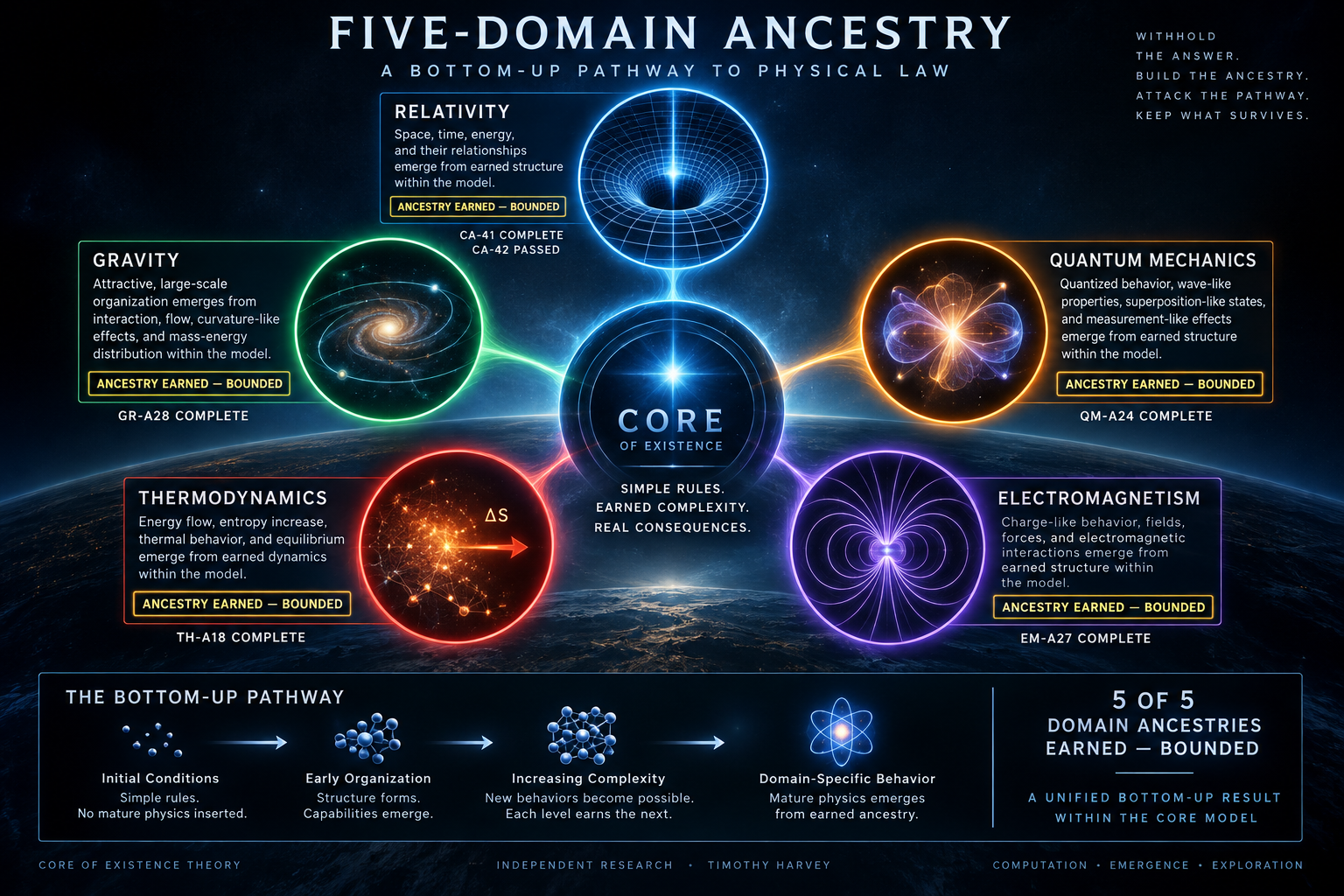
A dedicated ancestry program tested five mature domains of physical behavior separately: Relativity, Gravity, Thermodynamic/Statistical behavior, Quantum behavior, and Electromagnetic-like behavior. Mature versions of those theories were withheld as unexplained starting mechanisms while the model attempted to earn intermediate structure.
All five targeted pathways reached bounded earned status within the Core model. This does not establish an empirical derivation of established physics. It records that each tested domain developed a traceable bottom-up ancestry sufficient to cross its defined model adjudication threshold.
Five independently developed ancestry pathways reached bounded earned status within the broader Core framework.
Finite signal speed, frame-independent causal structure, Lorentz-like relationships, rest-state invariance, mass-energy-like structure, a zero-rest branch, and relativistic-dispersion-like behavior accumulated through the ancestry.
Content-dependent geometry, geometry-guided motion, backreaction, inverse-square-like weak behavior, clock-rate effects, redshift-like transfer, deflection, orbital structure, geometry waves, nonlinear behavior, and rotational effects were developed.
Multiplicity, entropy-like structure, statistical directionality, temperature-like equilibrium, heat/work-like transfer, free-energy-like behavior, canonical-like distributions, fluctuation response, irreversibility, and bounded thermalization were connected.
Interference-like probability, a Born-like rule, noncommuting-observable-like structure, Bell-type correlations, exchange structure, spin-like topology, field-like excitation, and decoherence-like classicalization were tested.
Conserved signed source structure, sign-sensitive response, inverse-square-like behavior, electric- and magnetic-like fields, induction, transverse propagation, photon-like excitation, gauge-like redundancy, and field-energy transfer emerged through the sequence.
Governing rule of the program: the mature destination is withheld while intermediate capability must earn its ancestry.
The gravity branch became the second of the five physical domains to reach bounded ancestry status. The complete sequence extended through GR-A28.
Localized mass-energy-like distribution produced a systematic change in relational geometry.
PASS — BOUNDEDAltered geometry generated approximately universal motion behavior without assigning separate gravitational response laws to different test structures.
PASS — STRONG BOUNDEDContent altered geometry and the changed geometry in turn altered motion, closing the basic two-way interaction loop.
PASS — BOUNDEDThe initial weak-field response passed while exact inverse-square behavior remained open. A later dimensional/geometric dilution test produced inverse-square-like behavior in effective three-dimensional geometry: available area increased approximately as r² while intensity decreased approximately as 1/r².
PASS — STRONG BOUNDEDThe emerging gravity-like pathway survived a stronger universality attack.
PASS — STRONG BOUNDEDGeometry-dependent clock-rate behavior emerged, followed by signal-transfer behavior consistent with the resulting clock-rate difference.
PASS — STRONG BOUNDEDThe same geometry responsible for ordinary free-motion-like response also deflected zero-rest-invariant limiting-speed excitations.
PASS — STRONG BOUNDEDThe ancestry progressed through trapping/horizon-like behavior, reversible escape when the source dropped below threshold, bound trajectories, Kepler-like scaling, periapsis-precession-like effects, propagation delay, geometry waves, wave energy/momentum, transverse structure, quadrupole-like radiation, and radiation-reaction-like orbital change.
MULTIPLE PASSES — BOUNDEDLater gates tested nonlinear geometry, strong-field bounded consistency, compression-versus-trapping separation, compression universality and sign reversal, moving-source geometry, a moving compression-corridor candidate, and rotational/frame-dragging-like structure.
BOUNDED ANCESTRYAfter the complete sequence and its attacks, the gravity domain was judged to have sufficient traceable ancestry to cross the bounded earned threshold.
ANCESTRY EARNED — BOUNDEDOrganization generated a bounded effective constraint capability that survived the corresponding attack.
PASS — BOUNDEDRelevant organization remained after a formation scaffold was removed, separating active maintenance from original formation support.
PASS — BOUNDEDDifferentiated functional roles emerged even though participating components followed the same underlying rules.
PASS — STRONG BOUNDEDA constrained tradeoff supported persistent specialization rather than simultaneous maximization of every capability.
PASS — STRONG BOUNDEDComplementarity increased robustness and functional dependence, although later attack showed that stronger mutual necessity had not yet been earned.
PASS — STRONG BOUNDEDThe tested organization did not cross the stronger whole-level mutual-necessity gate.
FAILBidirectional support emerged between differentiated functional structures.
PASS — STRONG BOUNDEDThe stronger reciprocal-repair claim failed. A narrower positive result survived: cross-support accelerated repair.
FAIL / WEAKER PASSRecent formation history was tested as a possible missing source of directional relational-constraint behavior. It failed decisively. Final-state microstructure predicted the outcome much more strongly than recent pathway information.
This redirected the investigation away from recent formation history and toward finer organization already present in the final state.
FAIL — DECISIVEOnce a sufficiently mature state crossed its gate, independently earned properties were frozen before the next organizational level was attempted. Higher destinations were not allowed to redesign the lower ancestry.
PPM89 crossed the Primitive Particle Gate. The following census retained persistent identity, characteristic scale, internal timescale, propagation, interaction response, provisional inertia-like response, a state-dependent boundary, and discreteness. These properties were then frozen before atom work.
PASS — BOUNDEDDirect attraction/repulsion polarity was not earned at the earlier particle stage. The failure remains part of the record even though charge-like behavior later became viable after deeper signed-source and field-like ancestry had been developed.
FAILPreviously earned particle-like entities formed a stable higher-order organization without inserting known atomic architecture.
PASS — BOUNDEDMultiple bound units produced stable but adaptable higher-order structures with emergent collective properties.
PASS — BOUNDEDExtended organization and bulk-like structural behavior crossed the bounded material-like gate.
PASS — BOUNDEDLater stages explored repair, distributed memory, reconstruction, sequence processing, and prediction. Generalization to novel damage did not automatically survive every attack, and those failures remain preserved.
MIXED / BOUNDEDThe later emergence pathway progressed through memory, reconstruction, prediction, predictive updating, and experience-dependent performance improvement.
EARNED — BOUNDEDThe ancestry later reached primitive agency-like behavior, internal-model-like organization, collective individuality, and recursive individuality. Counterfactual internal processing did not automatically survive its stronger gate and remains separately recorded.
BOUNDED / MIXEDWave Rider and the Compression Wing are maintained as downstream research branches. The key rule is unchanged: effective traversal may become extremely large through relational-path compression while local propagation remains at or below the model's limiting causal speed.
The Rider architecture progressed through formation, substrate coupling and alignment, commanded directional propagation, heading maintenance, and bounded cross-track correction.
STAGE 1 COMPLETE — TOY MODELEffective FTL-like destination reach emerged through compression of the relational path rather than local superluminal motion. The Rider does not need to traverse the full uncompressed reference distance.
Earlier earned multiscale networks progressed beyond the original low-compression regime into approximately 100–150c-equivalent, approximately 300c-equivalent, and eventually approximately 2000c-equivalent effective traversal regimes.
These values describe effective relational compression in the toy models. They are not measured spacecraft velocities and do not mean that a local object moved through ordinary space faster than light.
BOUNDED / TOY MODELIn the tested QG compression branch, the native configuration reached an effective traversal ceiling of approximately 1616c while retaining the local limiting-speed condition.
~1616c EFFECTIVE — TOY MODELA lateral-assistance branch identified a threshold near approximately 407 model units. At approximately 500 units, the tested configuration produced an effective traversal result near 2080c.
Again, the number is an effective compression/traversal factor inside the toy model—not a demonstrated physical velocity.
~2080c EFFECTIVE — TOY MODELCrossing the 2000c-equivalent regime established that the earlier approximately 67c scale was not a universal ceiling of the model. Sufficiently developed multiscale relational structure supported substantially deeper path compression.
Fixed network size still exhibited finite scale-depth saturation, while increasing relational extent allowed deeper earned scale structure.
MAJOR TOY-MODEL MILESTONEOnce the compression ancestry entered the 2000c+ regime, a new question became meaningful: does increasing compression remain a continuously shortened path, or can the same ancestry support a discrete stop-go pattern in which a compressed relational corridor is established toward a destination, traversed, terminated, and then re-established toward another destination?
No instantaneous teleportation mechanism has been earned. The hop idea remains a research hypothesis about the limiting behavior and controllability of extreme relational-path compression.
OPEN RESEARCH BRANCHThe gravity ancestry later produced a moving compression-corridor candidate. That result is deliberately kept separate from Wave Rider compression. Similar behavior is not treated as common mechanism until a dedicated compatibility or equivalence test earns the connection.
CONNECTION NOT YET EARNEDThe preserved wording for this research is: effective traversal via relational-path compression; local motion ≤ c. The 1616c and 2080c figures are toy-model effective traversal results, not claims of demonstrated physical spacecraft speed.
Core2 / Real Space restarted the investigation from minimal intrinsic properties and local relationships. Earlier Core results remain available as comparison records but are not automatically inherited.
Geometry, known particles, atomic structure, gravity, and compression were not declared as starting ingredients. The new pathway must independently earn whatever structure it develops.
ACTIVE RESEARCHEarly organization may create the potential for geometry-like structure, but mature geometry is not assumed merely because it appeared in the earlier Core ancestry.
METHODOLOGICAL CONSTRAINTCore2 is being watched for compression-related behavior without forcing it. If compression independently re-emerges, it can later be compared against the gravity compression corridor and the Wave Rider Compression Wing.
OPEN QUESTIONA provisional pathway connects relational structure, metric-like organization, effective dimensionality, and dynamic scale to an ARENA-like large-scale regime.
Toy coexistence models showed that increasing global extent and stabilized local organization can coexist rather than requiring one to eliminate the other.
An H²-proportional-to-density-like structural relationship appeared as a candidate mathematical pathway, with normalization and empirical correspondence remaining unresolved.
ARENA remains a bounded research branch. Cosmological mathematical consistency is not presented as an empirical derivation of standard cosmology.
Testing showed ordinary solar-wind pressure was many orders of magnitude too weak to supply planetary orbital acceleration. This killed that interpretation without killing the deeper active-medium ancestry question.
FAILED MECHANISMPhoton-like toy excitations with multiple internal frequencies followed the same Wake-conditioned relational path.
TOY-MODEL PASSA dominant frequency-independent relational path combined with a smaller chromatic term produced bending, convergence, lens geometry, and near-achromatic behavior.
TOY-MODEL PASSExploratory Wake-tonian work produced a Jupiter Trojan near-lock close to the expected 60-degree region and a Pluto–Neptune resonance toy closure without inserting mature gravity as the initial mechanism.
EXPLORATORY TOY RESULTSExploratory interaction-and-flow toy models generated filament-, node-, and void-like organization without mature gravity being inserted as the initial organizing mechanism.
EXPLORATORY TOY RESULTThe tested branch did not independently select the required rotation profile. That failure remains part of the Wake-tonian ancestry rather than being repaired by inserting the desired mature behavior.
FAILThe branch developed controlled threshold crossing, nested kill-switch and fallback concepts, and monitored interior/exterior transitions.
A stable spherical-form stage and controlled incremental expansion were developed at toy/conceptual level.
Later work focused on bridge/interface modules and structural connections between lower-level Core ancestry and higher geometric behavior.
Quantum Bubble is downstream speculative engineering research. Its results are not evidence establishing the Core theory itself.
A failed gate changes the ancestry just as surely as a pass. It prevents an unsupported mechanism from being quietly inherited by later research.
A later result is not allowed to reach backward and redesign an earlier stage simply because the mature destination would be easier to obtain that way. Earned properties are frozen, failures remain visible, and narrower interpretations replace stronger ones when attacks require it.
The milestones recorded here describe outcomes inside an evolving computational and conceptual research program. They may demonstrate mathematical possibility, bounded emergence, or internally consistent ancestry. They do not by themselves establish that corresponding mechanisms occur in nature.
Relativity, Gravity, Thermodynamic/Statistical behavior, Quantum behavior, and Electromagnetic-like behavior have each reached ANCESTRY EARNED — BOUNDED within the tested Core framework. Empirical correspondence, quantitative recovery of established physical laws, measured constants, and experimental validation remain separate questions.
Approximately 1616c native and approximately 2080c assisted results describe effective traversal factors produced by relational-path compression in specific toy-model branches. They do not represent measured physical velocities or evidence that a spacecraft can travel locally faster than light. The hop/stop-go regime remains an open research question.