Organizational Resilience Threshold
A combined structural diagnostic separated resilient from non-resilient toy-model organization across held-out trials.
TOY-MODEL PASSThis page collects successful, bounded, conditional, and earned results from the computational Core investigation. It is intentionally not a list of every run performed. The emphasis here is on findings that survived their stated gates strongly enough to contribute something to later ancestry.
Unless explicitly stated otherwise, the findings below come from computational or toy-model experiments. PASS means the defined gate was crossed within the tested model. BOUNDED means the finding remains limited to the demonstrated conditions. EARNED means the capability was permitted to become ancestry for later testing.
A result may resemble a particle, atom, gravitational effect, quantum behavior, thermodynamic process, electromagnetic interaction, memory system, or learning process without establishing that the model has reproduced the corresponding physical object or law in nature.
The completed five-domain program tested whether recognizable mature behavior associated with Relativity, Gravity, Quantum Mechanics, Thermodynamics, and Electromagnetism could be connected to bottom-up ancestry without granting the complete mature theory as an unexplained starting mechanism.
All five targeted domains crossed their respective ancestry thresholds within the Core model. Each remains bounded: the result establishes an internally earned pathway in the tested model, not empirical confirmation that the pathway is the origin of physical law in nature.
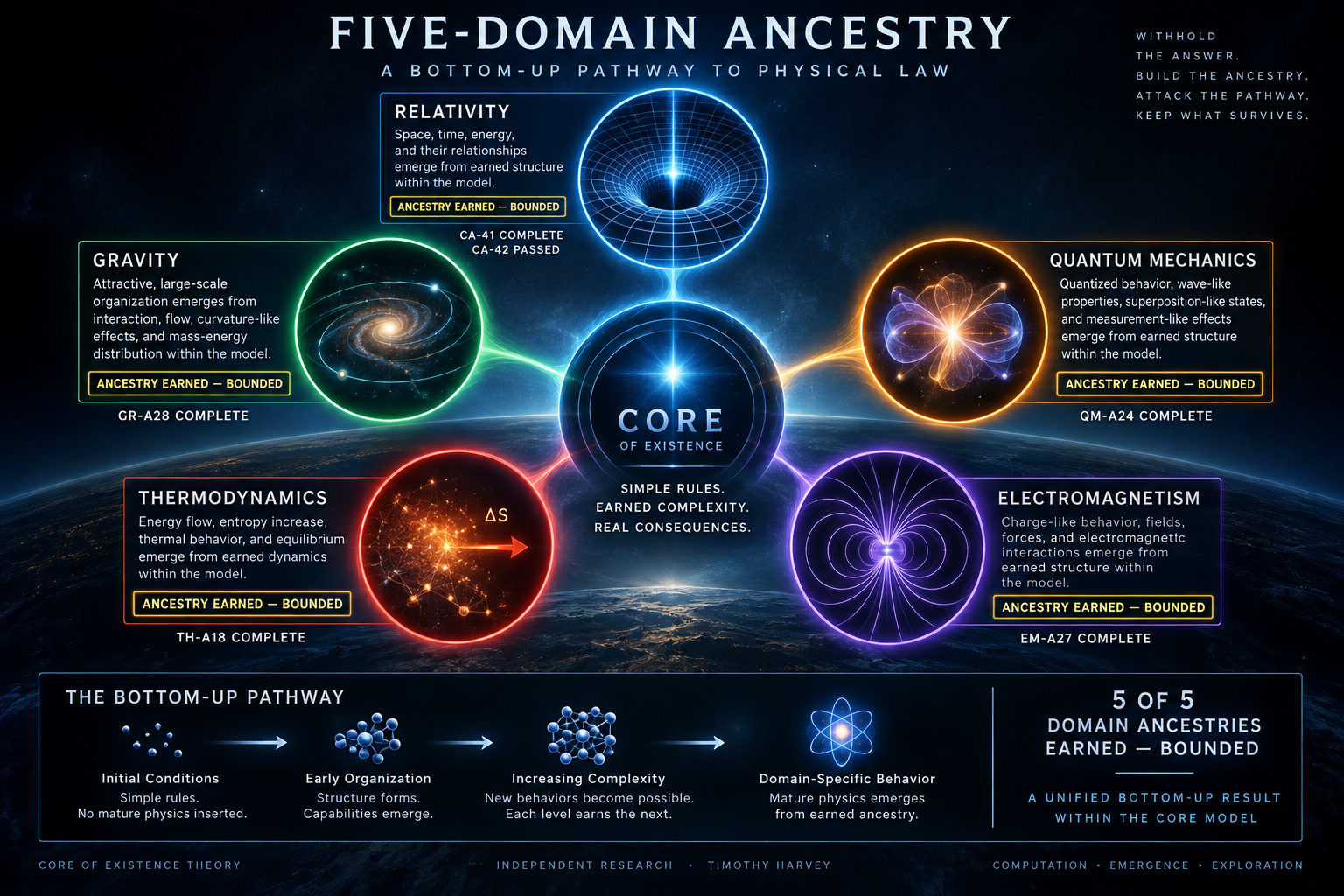
The five completed domain pathways and the bottom-up research architecture connecting them.
The relativity pathway tested whether relational structure could support progressively richer space-, time-, motion-, energy-, signaling-, and relativistic-behavior-like relationships without beginning with mature relativistic law.
Finding: the tested ancestry became sufficient to support bounded relativistic behavior, including the final dispersion-related gate used to close the domain pathway.
What it earned: Relativity became the first of the five major physical domains to reach ANCESTRY EARNED — BOUNDED.
The gravity sequence began with state-dependent relational geometry and progressively tested universal free-motion-like behavior, matter–geometry backreaction, weak-field response, geometric dilution, clock effects, signal redshift, trajectory deflection, and increasingly mature gravity-like geometry.
Selected result: effective three-dimensional geometric dilution produced an inverse-square-like weak-field relationship, with available area scaling approximately as r² and intensity correspondingly scaling as 1/r².
What it earned: the complete sequence through GR-A28 was sufficient for Gravity to reach ANCESTRY EARNED — BOUNDED.
The quantum ancestry asked whether behavior recognizable as discrete or quantized states, wave-like structure, superposition-like alternatives, probability-like outcomes, and measurement-related effects could emerge from previously earned organization rather than being inserted as a finished quantum formalism.
Finding: the tested structure supported a bounded ancestry in which quantum-like capabilities accumulated through successive gates rather than appearing as an assumed starting rule.
What it earned: completion through QM-A24 promoted Quantum Mechanics to ANCESTRY EARNED — BOUNDED.
The thermodynamic ancestry tested whether lower-level dynamics could support energy redistribution, statistical organization, entropy-like directional behavior, thermal-like effects, and equilibrium tendencies without inserting mature thermodynamic laws at the beginning.
Finding: energy-flow and entropy-like behavior emerged as collective consequences of the tested dynamics, together with bounded equilibrium-like organization.
What it earned: completion through TH-A18 promoted Thermodynamics to ANCESTRY EARNED — BOUNDED.
The electromagnetic ancestry tested whether charge-like differentiation, distributed field-like organization, force-like response, propagation, and electromagnetic-interaction-like behavior could develop from already earned relational and dynamical structure.
Finding: the tested ancestry supported linked charge-like, field-like, force-like, and propagating electromagnetic-like capabilities without granting mature electromagnetism as an initial law.
What it earned: completion through EM-A27 closed the fifth domain at ANCESTRY EARNED — BOUNDED.
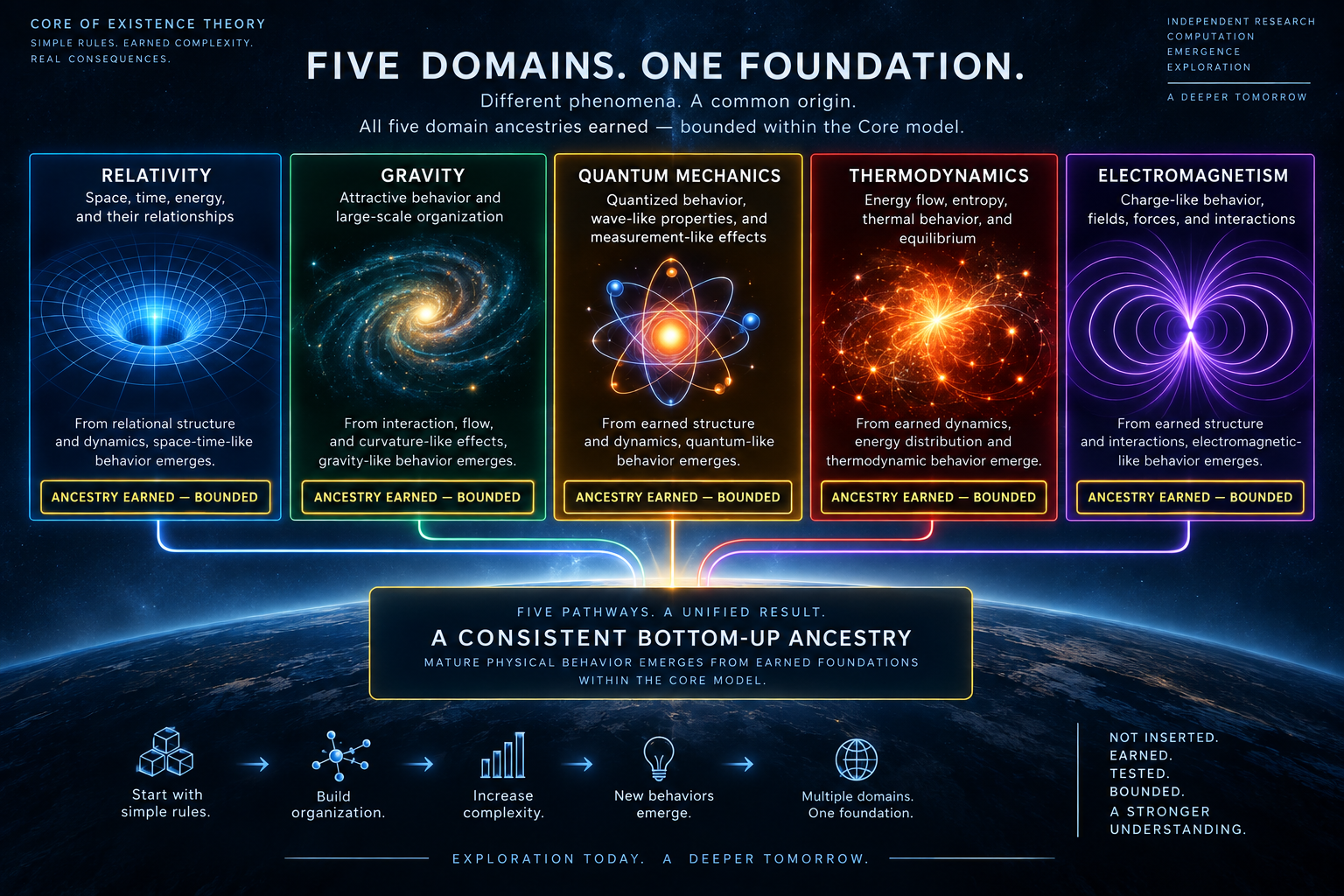
Different mature behaviors were tested separately, but under the same requirement: ancestry must be earned rather than inserted.
A combined structural diagnostic separated resilient from non-resilient toy-model organization across held-out trials.
TOY-MODEL PASSCrossing a bounded organizational threshold produced a measurable change in available capability.
PASS — BOUNDEDCapability depended systematically on organizational context rather than being explained by component count alone.
PASSOrganization produced an effective constraint-like capability not reducible to a simple independent-component description.
PASS — BOUNDEDA formed organization could retain relevant behavior after part of its formation scaffold was removed.
PASS — BOUNDEDComponents governed by identical underlying rules developed differentiated functional roles.
PASS — STRONG BOUNDEDLocal organization created differentiated operating conditions within the system itself.
PASS — BOUNDEDA constrained tradeoff supported stable specialization rather than universal optimization of every function.
PASS — STRONG BOUNDEDDifferentiated components produced complementary behavior and increased dependence, although stronger mutual necessity was not earned.
PASS — STRONG BOUNDEDBidirectional support emerged between differentiated parts of the organization.
PASS — STRONG BOUNDEDThe stronger obligatory reciprocal-repair interpretation failed, but cross-support accelerated repair as a narrower surviving result.
WEAKER PASSStable localized entities emerged with persistent identity-like behavior and resilience over time without predetermined known-particle properties.
EARNED IN MODELMultiple previously earned particle-like entities formed stable organized bindings and differentiated structural roles.
EARNED IN MODELMultiple bound units produced stable but adaptable higher structures with new collective properties.
EARNED — BOUNDEDExtended repeating organization, defect dynamics, bulk-like behavior, and scalable structural organization emerged.
EARNED — BOUNDEDExtended organization supported localized disruptions whose behavior could be tracked and constrained.
PASS — BOUNDEDDamage triggered local structural restoration rather than passive persistence alone.
PASS — BOUNDEDRecovery restored functional organization rather than merely replacing individual components.
PASS — BOUNDEDPresent organizational state altered subsequent local response in a stabilizing direction.
PASS — BOUNDEDPast system states influenced later response over a finite bounded history window.
PASS — BOUNDEDDistributed organization adapted through coordinated behavior rather than isolated component response alone.
PASSInformation about prior organization remained distributed across the system rather than residing in one designated memory element.
PASSIncomplete or damaged organization could recover a previously supported structural pattern.
PASSAdaptive performance extended beyond the exact states encountered during prior adjustment.
PASS — BOUNDEDPartial information was sufficient to drive reconstruction toward a previously organized pattern.
PASSOrdered history influenced processing in a way not reducible to isolated present-state response.
PASSThe system developed responses sensitive to what was likely to follow an observed sequence.
PASSPresent organization supported useful prediction of future system-relevant outcomes.
PASSPredictive behavior changed in response to accumulated outcome history.
PASSExperience-dependent predictive updating improved future performance strongly enough to cross the bounded learning-like gate.
EARNED — BOUNDEDPhoton-like excitations with different internal frequencies followed the same Wake-conditioned relational path in the tested toy model.
TOY-MODEL PASSA shared relational pathway supported bending, convergence, lens geometry, and near-achromatic behavior within the toy architecture.
TOY-MODEL PASSImpact-dependent trajectory bending emerged within the tested relational pathway.
TOY PASSDeflected paths converged downstream in a lens-like geometric arrangement.
TOY PASSThe dominant relational path remained nearly independent of excitation frequency.
TOY PASSFilament-, node-, and void-like organization appeared in exploratory interaction-and-flow models without gravity being inserted as the initial organizing mechanism.
TOY-MODEL RESULTThe Stage-1 Rider achieved commanded directional propagation, heading maintenance, and bounded correction in the toy architecture.
STAGE 1 — PASSEffective travel distance was reduced through relational-path compression while local propagation remained within the model's limiting-speed rule.
PASS — BOUNDEDLarger earned multiscale networks produced very large toy compression factors while preserving the distinction between effective FTL travel and local superluminal motion.
PASS — BOUNDEDFailures are not erased from Core. They remain essential to the research because they close mechanisms, weaken interpretations, and prevent later ancestry from inheriting capabilities that were not earned.
The Research Archive and detailed preservation notebooks retain failed gates, corrections, conditional outcomes, sidelined branches, and stronger re-attacks. This page has a narrower job: show a curious reader what survived.