EMERGENCE RESEARCH

From pre-particle organization to higher capability.

This branch of the Core investigation asks a deliberately demanding question: how much recognizable organization can emerge if mature particles, atoms, molecules, materials, memory, prediction, and learning are not placed into the model at the beginning?

Start simple.
Freeze what survives.
Build only from what has been earned.

Then see how far organization can go.

A continuous ancestry of emergent organization.

The research began below anything that could reasonably be called a particle. Stable organization had to emerge first. Once a capability survived testing, its properties were frozen before the next level was attempted.

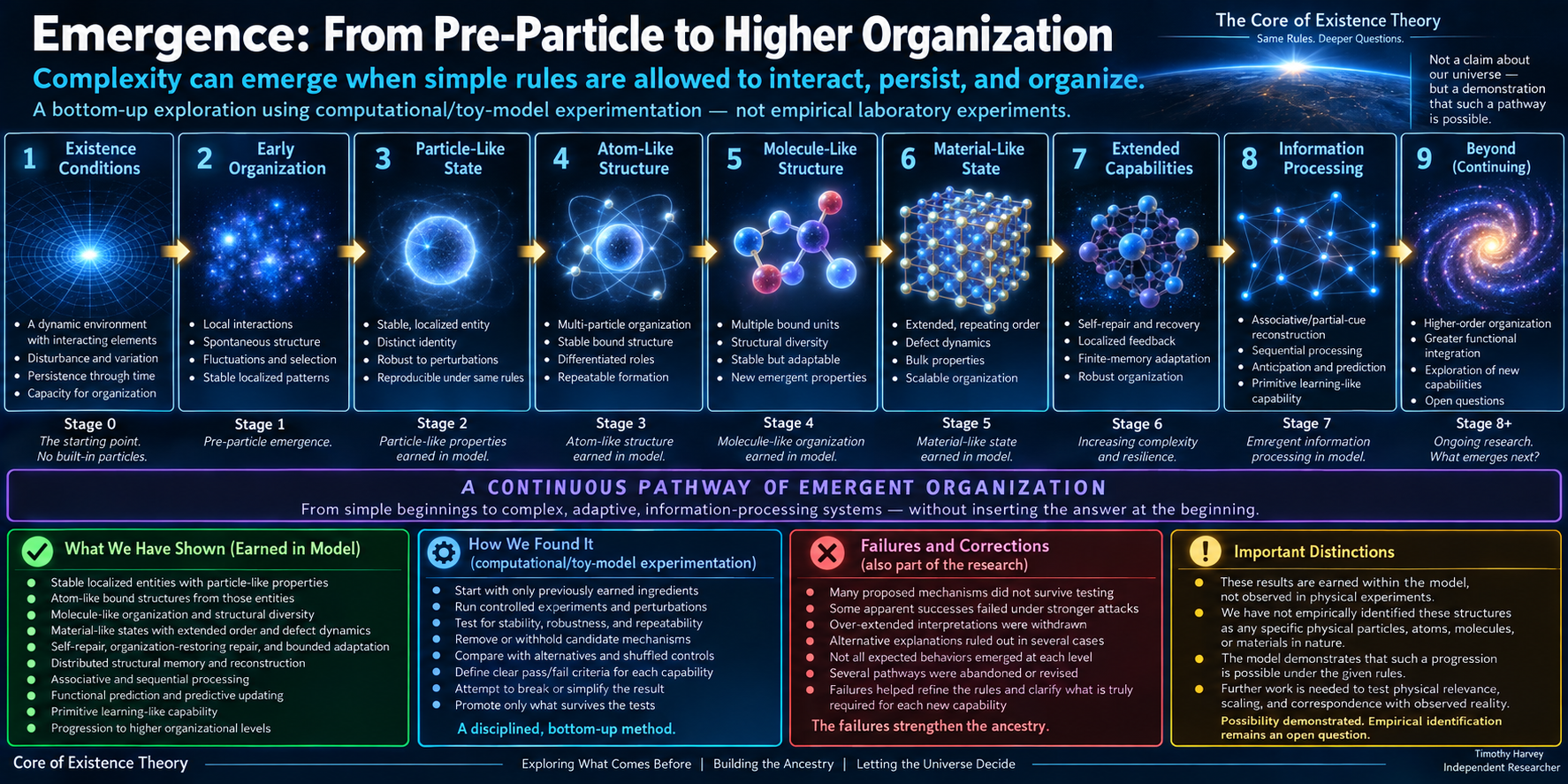
Emergence ancestry from pre-particle organization to higher organization

A summary of the computational ancestry explored in the Core model. The labels describe behaviors earned within the model, not empirical identification with specific physical particles, atoms, molecules, materials, or biological systems.

Computational experimentation, not destination fitting.

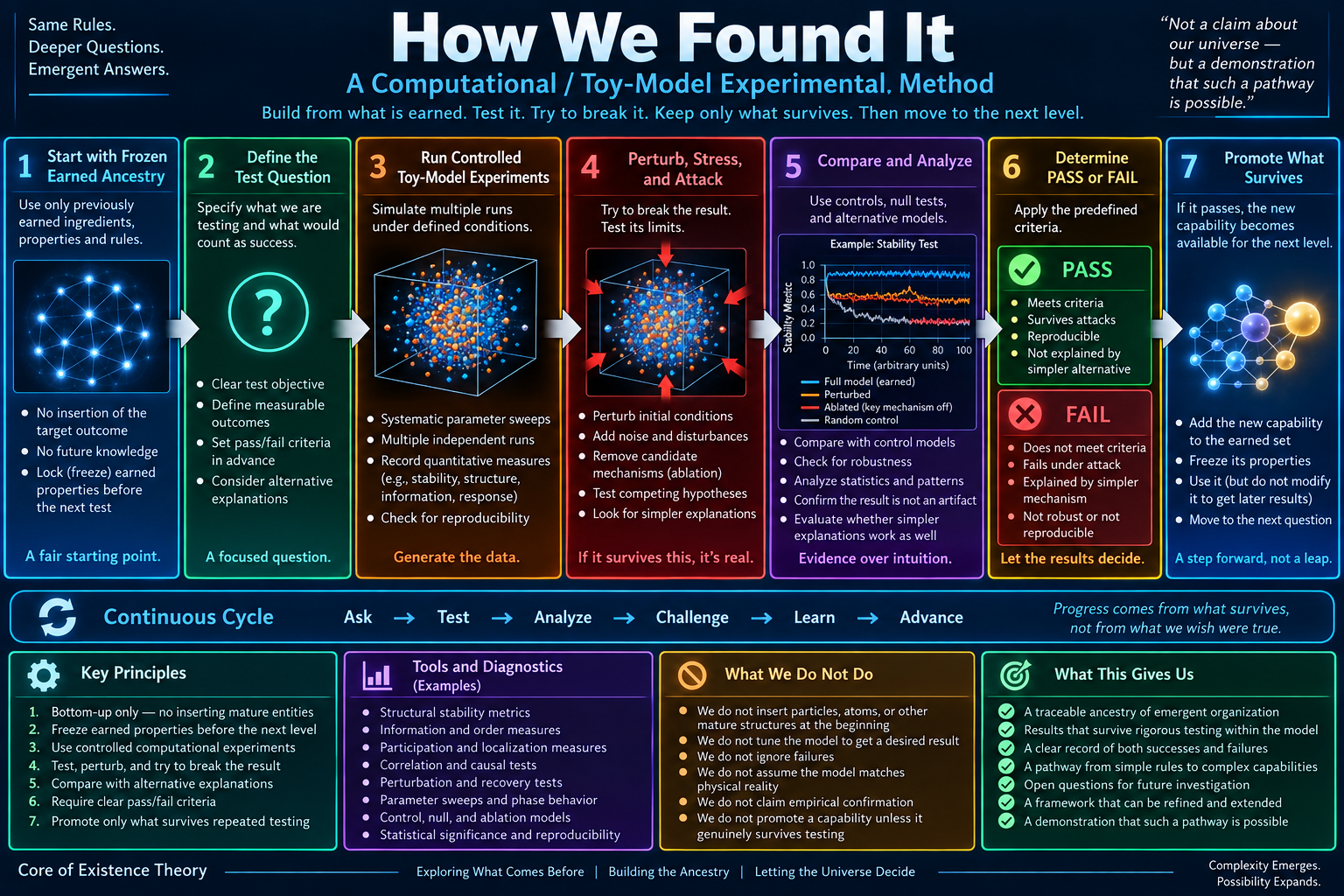
The model is treated as an experimental environment. Candidate capabilities are tested, perturbed, compared with controls, attacked, and either promoted or rejected.

How the Core computational toy-model experimental method works

Previously earned structure is frozen, a new question is posed, controlled runs are performed, apparent successes are attacked, alternatives are compared, and only surviving capabilities advance.

Freeze the ancestry

Previously earned properties are locked before the next level begins. Earlier structures are not redesigned to make later outcomes work.

Define the gate first

A capability needs measurable criteria before the result is known. The target is not allowed to move after the run.

Attack apparent success

Perturbations, ablations, controls, alternative explanations, and stronger re-tests are used to challenge the interpretation.

Promote only what survives

A failed mechanism is not hidden. A bounded success remains bounded. Only surviving capability becomes ancestry for the next level.

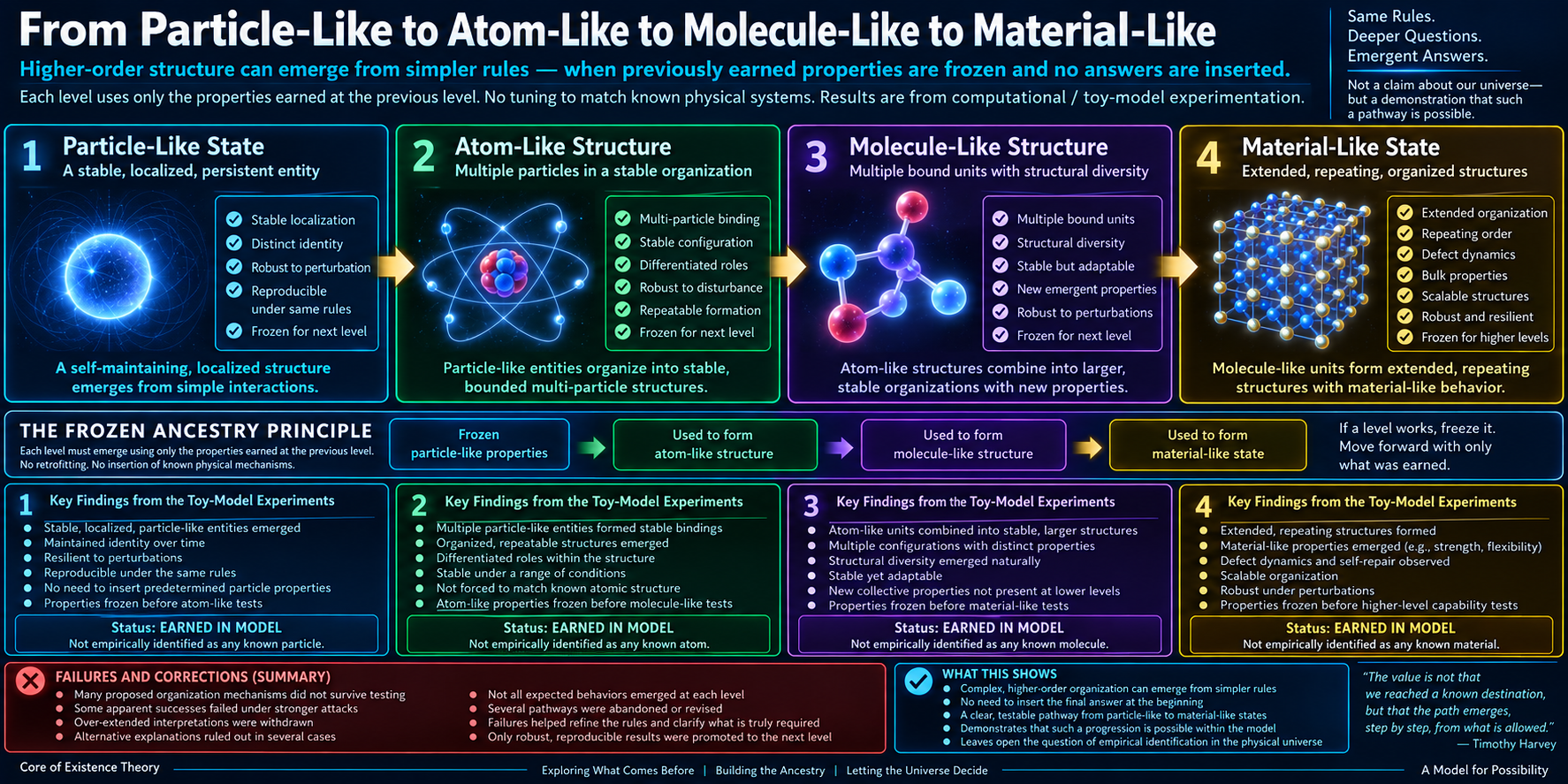
Particle-like → atom-like → molecule-like → material-like.

One of the most important methodological rules was simple: once particle-like properties were earned, those properties were frozen before atom-like organization was tested. The same rule continued upward.

Particle-like to atom-like to molecule-like to material-like emergence

Each stage uses the frozen capabilities of the stage below it. The model was not tuned to reproduce a known electron, proton, atom, molecule, or material.

EARNED IN MODEL

Particle-Like Organization

Stable localized organization developed persistent identity-like behavior, resilience to perturbation, and reproducibility under the same underlying rules.

EARNED IN MODEL

Atom-Like Organization

Frozen particle-like entities supported stable multi-entity organization with differentiated relational roles and repeatable bounded structure.

EARNED — BOUNDED

Molecule-Like Organization

Multiple atom-like units formed larger stable organizations with structural diversity and collective properties absent from isolated units.

EARNED — BOUNDED

Material-Like State

Extended repeating organization emerged together with defect dynamics, scalable structure, and behavior resembling an organized material state.

IMPORTANT DISTINCTION

No Empirical Identification

The model has not identified its particle-like state as an electron, proton, quark, or any other known physical particle.

IMPORTANT DISTINCTION

Possibility, Not Confirmation

The result demonstrates that such an ancestry can occur under the tested model rules. Whether nature uses the same ancestry remains open.

The investigation did not stop at structure.

Once extended organization became stable enough to persist, the next question changed: could organized structure begin doing something with its own state and history?

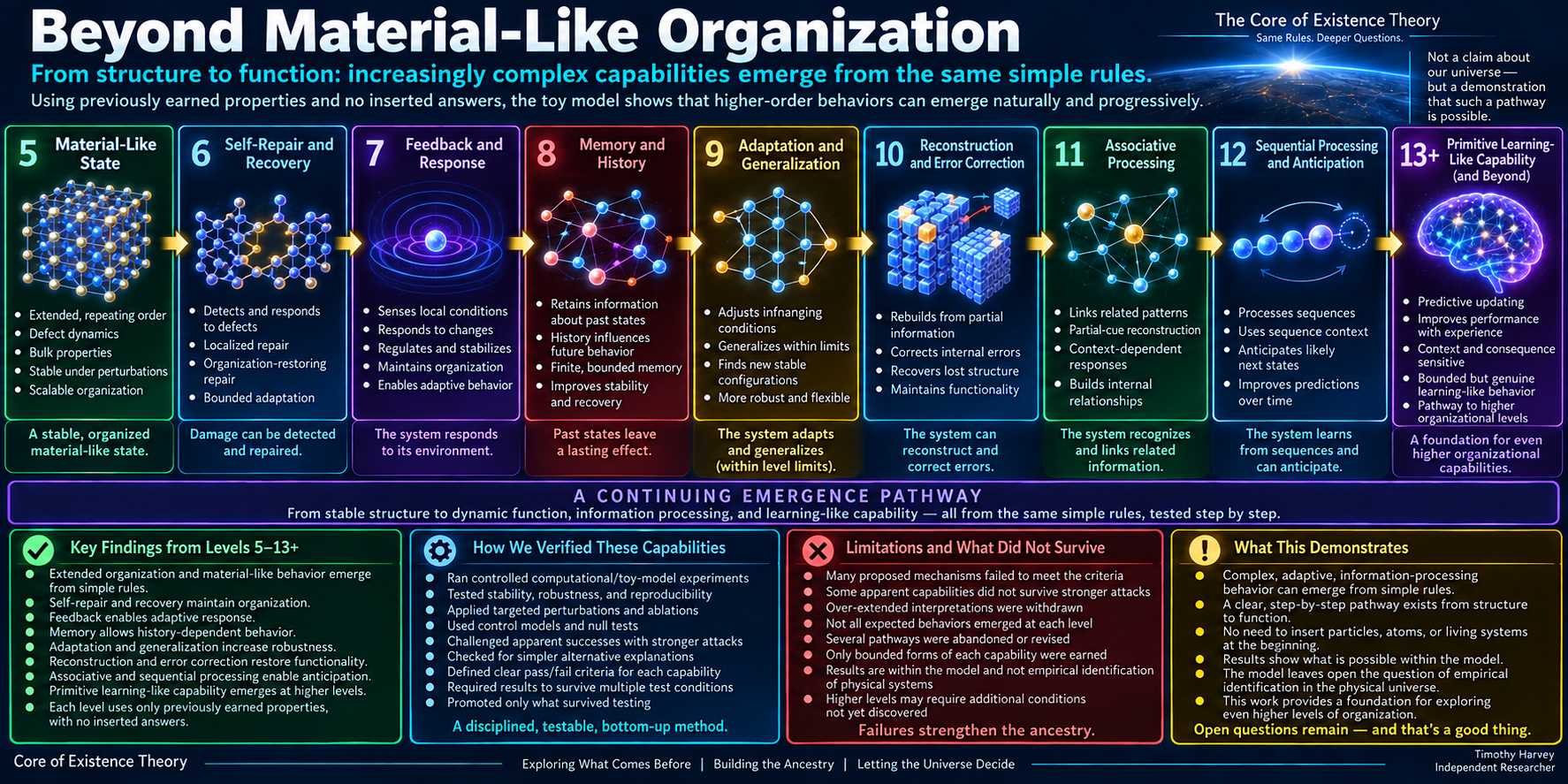
Beyond material-like organization showing repair memory adaptation reconstruction prediction and learning-like capability

The later model progression moved from structure toward function: repair, feedback, memory, adaptation, reconstruction, associative processing, sequential processing, anticipation, prediction, and bounded learning-like capability.

EXTENDED ORDER
Repeating organization became capable of supporting defect dynamics rather than simply collapsing when local structure changed.
SELF-REPAIR
Localized structural damage could be detected and repaired, including bounded recovery of organization rather than mere replacement of individual elements.
FEEDBACK
Local conditions began influencing subsequent structural response, producing feedback-like regulation and context-dependent behavior.
MEMORY
Past states began leaving functional consequences. The organization could retain bounded information that influenced later behavior.
ADAPTATION
The system gained the ability to adjust to changing conditions and, within limits, generalize beyond a single previously encountered configuration.
RECONSTRUCTION
Partial information could support reconstruction and error correction, allowing damaged or incomplete patterns to recover organized function.
ASSOCIATION
Relational patterns could become linked so that partial cues influenced the reconstruction or activation of associated structure.
SEQUENCES
The model progressed from static relationships to sequence-conditioned processing in which order and recent history affected later response.
ANTICIPATION
Sequence-conditioned behavior produced bounded anticipation of likely next states rather than response only to the immediate present.
PREDICTION
Predictive behavior became functional: model state could be updated from experience and used to improve subsequent response.
LEARNING-LIKE
The accumulated capabilities crossed a bounded primitive learning-like threshold within the model: experience altered future performance in a repeatable and testable way.

How we measure whether organization really changed.

The mathematics varies by experiment, but several recurring diagnostics help separate a visually interesting pattern from a genuinely different organizational state.

State Evolution

x(t+1) = F[x(t), A(t), C(t), Θ]

The system state at the next step depends on the current state, relational structure, constraints, and fixed model parameters. The important question is whether new organization emerges from the update rule rather than being manually inserted.

Changing Relations

Aᵢⱼ(t+1) = G[Aᵢⱼ(t), xᵢ(t), xⱼ(t), C(t)]

Relations themselves may evolve. This allows organization to become history-dependent rather than remaining a permanently fixed network.

Relational Organization

M(t) = Φ({xᵢ(t)}, {Aᵢⱼ(t)})

A higher-level measure summarizes organization across the system. Depending on the test, this can include coherence, persistence, connectivity, differentiation, localization, information retention, or collective behavior.

Participation / Localization

P = (Σᵢ wᵢ²)² / Σᵢ wᵢ⁴

Participation-style measures help determine whether activity is localized, distributed, or reorganized across many components.

Information Dependence

I(X;Y) = Σ p(x,y) log[p(x,y)/(p(x)p(y))]

Mutual information is useful when testing whether one part of the model carries predictive or reconstructive information about another.

Recovery After Damage

Gᵣ = Rpost / Rpre

A recovery ratio compares organization after perturbation with the pre-damage state. A high value alone is not enough; the recovered organization must also preserve the relevant functional relationships.

Contribution of a Candidate Mechanism

ΔP = P(Survival | A) − P(Survival | ¬A)

Ablation asks whether a candidate mechanism actually matters. If removing it leaves the result unchanged, the mechanism has not earned causal status.

Emergence Gate

E = H(K−Kc) · H(P−Pc) · H(R−Rc)

A candidate capability can be required to cross several thresholds simultaneously, such as coherence, persistence, and relational organization, before being promoted.
The mathematics is not there to decorate the story.

It is there to make the story easier to kill if it is wrong.

The ancestry includes the things that did not work.

Hundreds of individual runs and gates are not reproduced here, but failed mechanisms, over-strong interpretations, and abandoned routes materially shaped the pathway.

Failures & Corrections — Summary

Mechanisms that looked promising failed.

Some candidate mechanisms produced attractive patterns but collapsed under perturbation, stronger controls, or longer runs.

Apparent causation disappeared under ablation.

Several mechanisms were initially associated with a capability but proved unnecessary when removed or replaced.

Over-strong interpretations were withdrawn.

When the model supported only a bounded version of a claim, the stronger interpretation was not retained.

Some capabilities did not appear at the expected level.

The model sometimes reached a genuine structural wall. Progress resumed only after additional ancestry was earned.

Alternative explanations survived.

When a simpler explanation remained sufficient, the more elaborate interpretation was not promoted.

Whole-level mutual dependence sometimes failed.

Cross-support and repair acceleration could emerge without establishing the stronger claim of complete reciprocal necessity.

Recent pathway history was not always the missing variable.

In one major attack, detailed final-state structure predicted outcome better than the tested recent formation pathway.

Failure refined the next question.

A failed test did not reset the project. It narrowed the ancestry by showing what could no longer be assumed.

A model can climb much farther than expected.

MODEL RESULT

Stable Identity-Like Organization

Localized organization can become persistent, reproducible, and resistant to perturbation without inserting a finished particle.

MODEL RESULT

Hierarchical Structure

Previously earned units can participate in larger bounded organizations with new collective properties.

MODEL RESULT

Structural Repair

Damage can trigger bounded recovery of organization rather than simple collapse.

MODEL RESULT

Memory and History

Past states can leave functional consequences that influence present and future behavior.

BOUNDED RESULT

Adaptation and Generalization

The model can adjust to changing conditions and transfer limited organization across related circumstances.

MODEL RESULT

Error Correction

Incomplete or damaged information can support reconstruction of organized state.

MODEL RESULT

Associative Processing

Partial cues and relational structure can influence reconstruction and linked response.

MODEL RESULT

Sequential Processing

The order of events can matter, allowing response to depend on sequence and recent context.

EARNED — BOUNDED

Primitive Learning-Like Capability

Experience can alter later performance in a repeatable way, producing a bounded learning-like capability within the toy model.

Earned in the model is not the same as identified in nature.

What “particle-like,” “atom-like,” and “learning-like” mean here

These names describe functional similarities in the computational model. They do not mean that a known physical electron, proton, atom, molecule, material, biological organism, nervous system, or mind has been reproduced.

The model result is narrower and more defensible: under the tested rules, increasingly complex organization can emerge through a traceable ancestry without inserting the mature destination at the beginning.

The next scientific question is correspondence: whether any part of that ancestry maps onto physical reality, at what scale, and under what measurable conditions.

The destination is not the most interesting part.

The deeper result is that a single ancestry can keep generating new organizational possibilities as previously earned structure becomes available to the next level.

Particle-like organization was not the end.

It became ancestry.

Atom-like organization became ancestry.

Material-like organization became ancestry.

And eventually structure began to repair, remember, reconstruct, anticipate, and learn.

What comes after learning-like organization?

The active research now asks whether the later organizational capabilities can continue to deepen without silently importing mature biological, cognitive, or physical structures. The same rule remains in force: whatever comes next must earn its ancestry.

Complexity is allowed to surprise us.

It is not allowed to skip the test.

Possibility demonstrated. Physical correspondence still open.

These results come from controlled computational and toy-model experiments within the Core of Existence research framework. They establish what the tested model can do. They do not, by themselves, establish that nature follows the same pathway.

Start with what is earned.
Freeze the ancestry.
Test the next possibility.
Attack what appears.
Keep only what survives.

Then move forward.