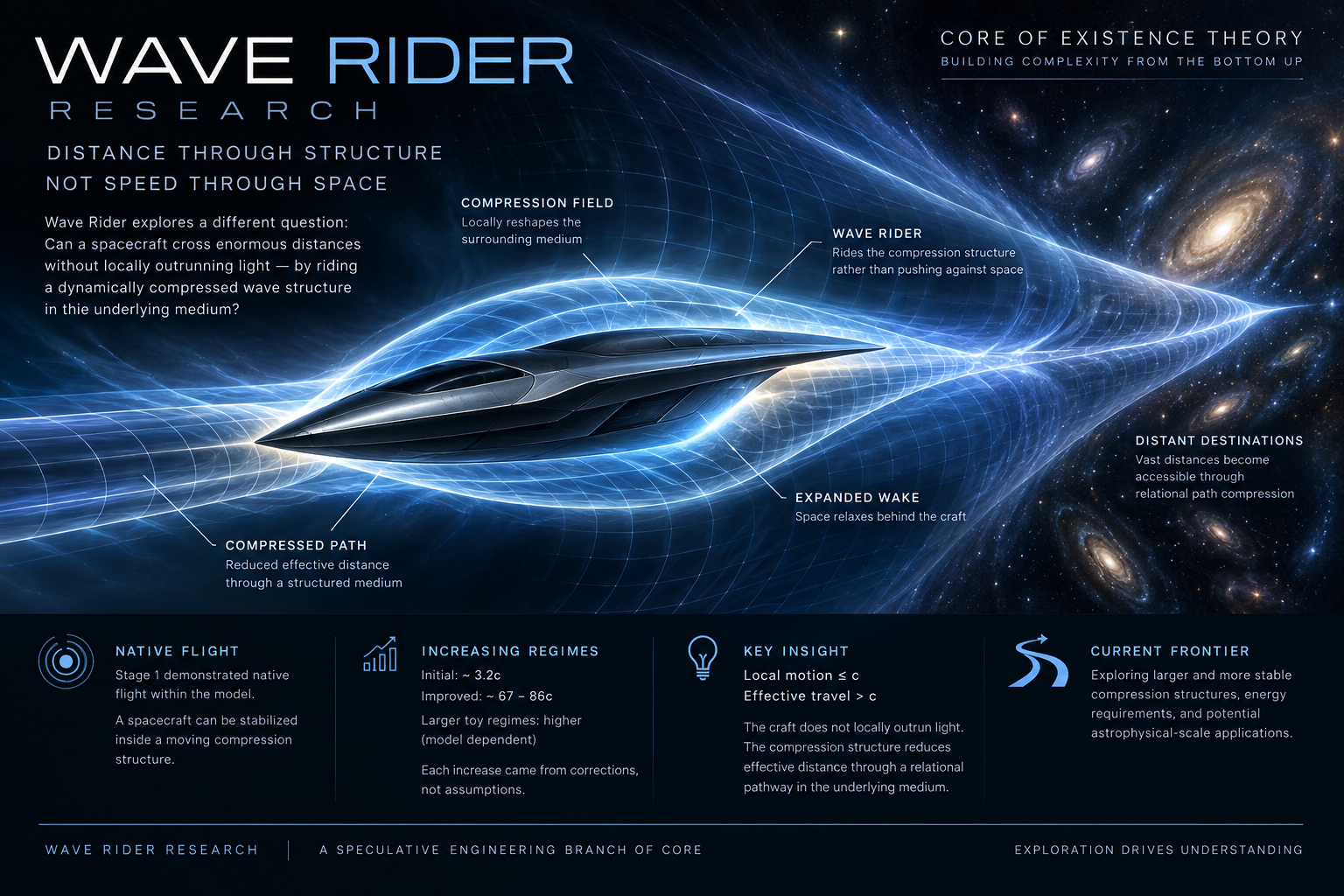
Wave Rider is a separate exploratory branch of the Core research program. Rather than asking how a vehicle might simply move faster through ordinary space, the research asks whether the effective path between locations can become shorter through an earned change in relational structure.
The central Wave Rider distinction is simple but important. The vehicle does not need to travel locally faster than light if the relational distance it must cross can be reduced.
In the current toy-model interpretation, local propagation remains bounded at or below the ordinary limiting speed. The apparently faster journey arises because the modeled path itself becomes shorter.
Numbers such as 3.2c, 67–86c, hundreds of c, or thousands of c therefore refer to effective compression-equivalent travel in the model. They are not measured spacecraft velocities.
The ultimate Wave Rider question is not how fast a spacecraft can be pushed through ordinary distance. It is whether the effective relational distance between departure and destination could become so dramatically reduced that an astronomical journey behaves as though the destination were nearly adjacent.
The Compression Wing investigates whether a sufficiently organized relational structure can produce a persistent directional shortening of the path ahead of a Rider while maintaining controlled propagation.
Wave Rider did not begin with an FTL mechanism. Each stage had to inherit only what earlier stages had already earned, while failed mechanisms and unsupported shortcuts were kept separate.
Establish a persistent controllable Rider structure capable of maintaining its organization.
Earn directional propagation, heading control, cross-track correction, and sustained Stage-1 motion.
Test whether relational path shortening can coexist with controlled Rider behavior.
Increase modeled relational depth and determine when larger compression factors survive stability and structure requirements.
Stress the handoff between very large compression regimes and previously earned Stage-1 Rider behavior.
The Rider ancestry reached a toy-model stage in which formation, coupling, directional propagation, heading hold, and cross-track correction could operate together.
Early corridor models produced effective compression-equivalent travel on the order of approximately 3.2c while preserving the distinction between local propagation and effective path shortening.
Later multiscale models reached tens, hundreds, and in some configurations thousands of times ordinary effective travel distance reduction.
Large compression cannot simply be assigned. The model must earn sufficient relational depth, connectivity, participation, and structural support.
Several proposed universal thresholds and simplified order parameters failed to generalize. Those branches were not promoted simply because compression itself remained promising.
The current research frontier examines whether extremely large compression states can transition cleanly back into the previously earned native-flight architecture.
The next meaningful question is not simply whether a large compression number can appear. It is whether the Rider can survive the transition between the large-compression regime and its independently earned Stage-1 flight state.
A successful transition must preserve the relevant Rider structure, maintain controllability, avoid catastrophic loss of the compression corridor, and return to a valid Stage-1 flight condition without inserting a repair mechanism after the fact.
If that transition cannot survive the required stresses, the large compression regime does not automatically count as a usable propulsion pathway.
The research increasingly points toward relational path compression rather than superluminal local motion. That keeps the conceptual mechanism distinct from simply accelerating a spacecraft beyond the local limiting speed.
The strongest compression regimes appear only when sufficient multiscale relational structure is available. Fixed or poorly connected structures eventually saturate or degrade.
Rejected predictors, sidelined branches, and failed transitions are part of the ancestry. They help define what the surviving Compression Wing is allowed to claim.
The Rider and Compression Wing are computational research constructs. No physical propulsion system, engineered metric, spacecraft hardware, or experimentally demonstrated FTL technology currently exists from this work.
A deliberately ambitious target can be useful even if the present model never reaches it. Near-instantaneous destination reach forces the research to identify exactly what prevents deeper compression, where stability fails, which transitions become destructive, and which assumptions eventually stop scaling.
If a physical or mathematical barrier ultimately prevents the Wave Rider ancestry from approaching near-instantaneous destination reach, that barrier is itself an important result.
Conversely, if a future mechanism, correction, or entirely different pathway survives stronger testing, it must still earn its place without being inserted simply because it helps reach the destination.
Wave Rider is a computational and conceptual research program. The reported compression factors are toy-model effective path ratios, not measured spacecraft speeds. The work does not demonstrate an operational warp drive, faster-than-light spacecraft, engineered spacetime manipulation, or a physically realizable propulsion technology.
Its present value is narrower: it provides a testable ancestry framework for asking whether extreme effective travel could arise from structural path reduction while local propagation remains bounded.