THE RESEARCH

A growing ancestry of tested pathways.

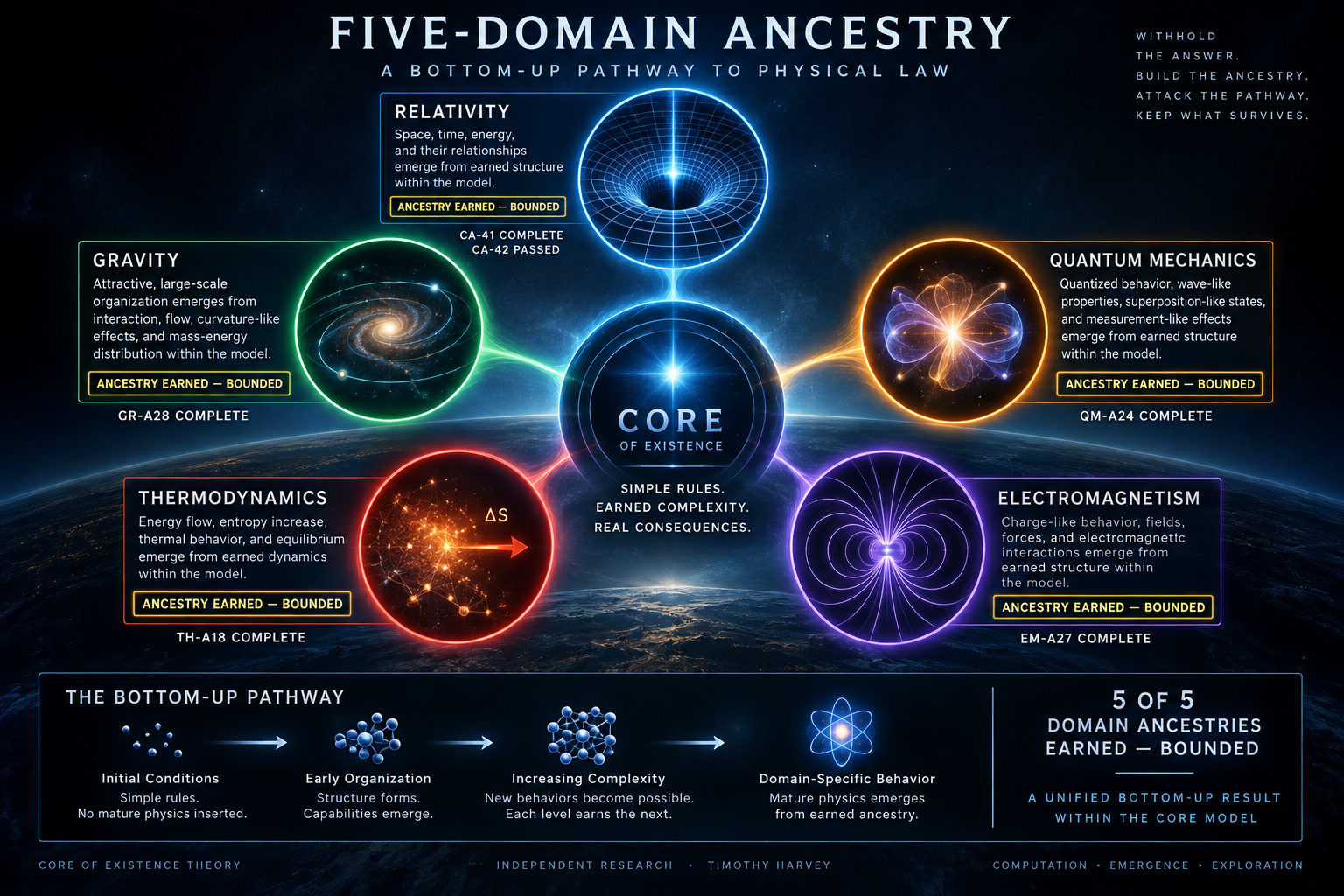
Core research is organized as a set of linked but distinct investigations. Each branch has its own ancestry, limits, unresolved questions, and test history. Results are carried forward only within the scope actually earned.

Core of Existence symbol

Different questions, one ancestry discipline.

The branches below are related by method, but they are not treated as interchangeable. A result earned in one branch is not automatically imported into another.

PRIMARY RESEARCH — ACTIVE

Core Ancestry / Pre-Particle Emergence

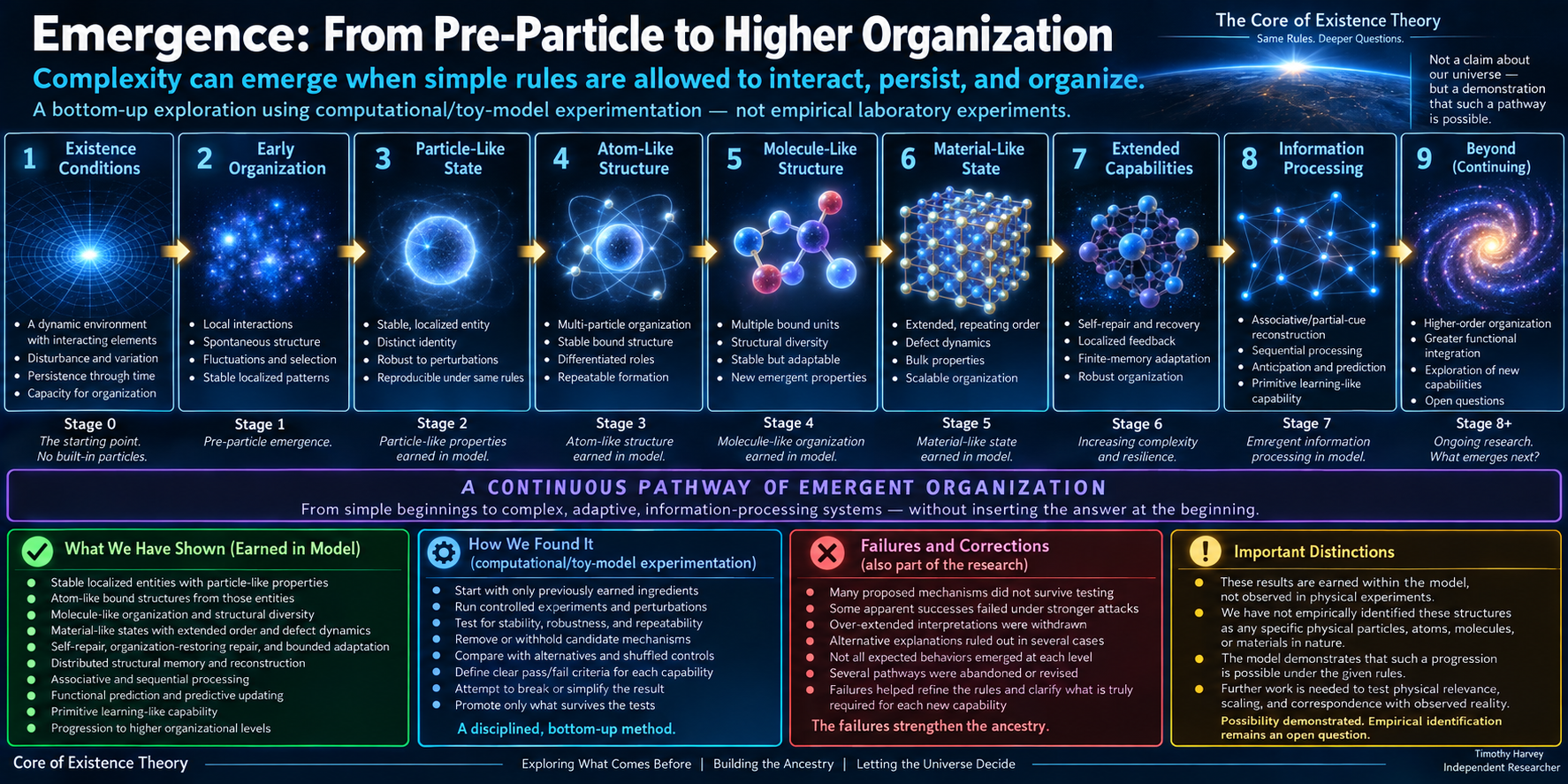
The main bottom-up investigation. Current work examines how persistence, specialization, dependence, constraint, and stable higher-level identity might arise before mature particle descriptions are allowed.

ACTIVE — BOUNDED

ARENA / Cosmology

Explores whether large-scale organization, expansion, density relations, persistence windows, and cosmological behavior can emerge from previously earned relational structure without assuming a completed cosmology at the start.

STAGE 1 EARNED — TOY MODEL

Wave Rider / Compression Wing

Investigates commanded propagation and relational path compression. Native Stage-1 flight has been earned at toy-model level, while effective FTL remains a path-compression result rather than local faster-than-light motion.

EXPLORATORY

Wake-tonian / IVD

Tests whether organized flow, wake, shear, spin, and entrainment can reproduce selected orbit-like behaviors through an alternative ancestry. It is a methodological exploration, not an established replacement for gravity.

SEPARATE DEVELOPMENT BRANCH

Quantum Bubble

A separate propulsion-oriented ancestry investigating stable form, interface behavior, threshold control, gateways, expansion, and failure protection without merging its results into the main Core pathway by default.

What the current ancestry has actually earned.

These examples illustrate how the research ledger distinguishes durable gains from failed or incomplete mechanisms.

Effective Constraint — PASS — BOUNDED A higher-level constraint effect survived within the tested regime, but remains limited to the conditions under which it was demonstrated.
Specialization — PASS — STRONG BOUNDED Identical underlying rules produced differentiated functional roles under the tested conditions.
Tradeoff Structure — PASS — STRONG BOUNDED The system produced specialization under a constrained tradeoff rather than allowing every component to maximize every role simultaneously.
Cross-Support — PASS — STRONG BOUNDED Bidirectional support emerged between specialized components, establishing a stronger form of organized dependence.
Cooperative Closure — FAIL The tested system did not establish whole-level mutual necessity strongly enough to earn cooperative closure.
Reciprocal Repair — FAIL / WEAKER PASS Obligatory reciprocal repair failed, although a weaker effect showing repair acceleration survived.
Recent Formation Pathway — FAIL Recent transformation history did not supply the missing explanatory information once sufficiently detailed final-state structure was considered.

Every result carries its boundary with it.

PASS

The stated mechanism survived the stated test.

BOUNDED

The result survived, but only within a restricted regime.

CONDITIONAL

The pathway remains open, but unresolved bridges or controls remain.

FAIL

The proposed mechanism did not survive and cannot be treated as earned ancestry.

The important gaps are still visible.

Core does not treat unfinished bridges as inconvenient details. They define the actual research frontier.

Stable Identity

Can organization preserve a recognizable whole through change rather than merely persisting as a temporary pattern?

Mutual Necessity

Can specialized components become genuinely necessary to one another rather than merely beneficial?

Repair and Maintenance

Can organization develop active internal maintenance strong enough to support long-lived identity?

Particle-Like Behavior

Can stable, distinguishable, interaction-capable entities emerge without mature particle properties being inserted in advance?

Physical Correspondence

Where, if anywhere, do earned model behaviors begin to correspond quantitatively with known physical systems?

Ancestry Continuity

Can each higher-level capability be connected continuously to earlier earned structure without a hidden jump in mechanism?

Model success is not physical confirmation.

Core distinguishes between demonstrating that a mechanism can arise in a controlled model and demonstrating that nature actually uses that mechanism.

What a PASS means

A PASS means the proposed mechanism survived the particular model test that was designed to challenge it. It does not mean the mechanism has been experimentally confirmed in nature, nor does it convert a toy-model result into an established physical law.